Bilingual ABA in New Mexico: The Importance of Culturally Responsive Care
Many families across New Mexico — in Albuquerque, Las Cruces, Santa Fe, and communities in between — live and parent in more than one language. Spanish may be the language used for important conversations, for soothing a child at bedtime, for explaining something complicated to a grandparent who helps with daily care. And yet, when those same families enter the autism and ABA services system, many families find that key information, explanations, and caregiver coaching are not consistently available in their preferred language.
That gap matters more than it might seem. When caregivers cannot comfortably ask questions about a treatment plan, express concerns about how strategies are working at home, or fully understand the goals their child is working toward in therapy, trust can weaken — quietly, and sometimes without anyone realizing it is happening.
Bilingual ABA therapy is not an extra feature. It is part of what makes care genuinely effective for families whose lives happen in more than one language.
Why Language Matters in Behavioral Success
ABA therapy is, at its foundation, a collaborative process. A BCBA (Board Certified Behavior Analyst) and the family are working together to understand the child's behavior, set meaningful goals, and build strategies that will carry over into daily life at home. That collaboration depends entirely on communication — and communication depends on language.
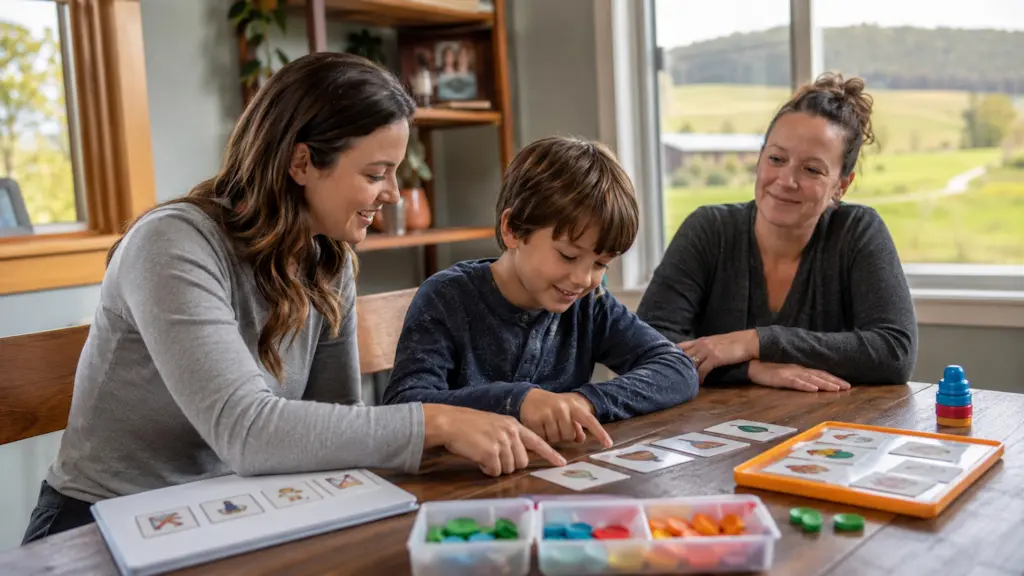
Parent training and caregiver coaching are central to how ABA produces lasting change. When a therapist explains a replacement behavior strategy to a parent, or reviews data from the week's sessions, or coaches a caregiver on how to respond during a difficult moment at dinner, the value of that exchange depends on whether the parent truly understands what is being said. Not just the words, but the reasoning, the nuance, the "why" behind the approach.
When Understanding Is Incomplete, Follow-Through Suffers
Consider a few situations that can arise when language access is limited:
• A parent is taught how to use a replacement behavior strategy during a session. At home, they are unsure how to explain the approach to grandparents who help with after-school care. The grandparents use what has always worked for them. The consistency the therapy team is building begins to erode.
• A caregiver follows the therapist's routine because they trust the process, but they do not fully understand the reason behind it. When life gets stressful — during a holiday, an illness, a move — they fall back on familiar responses because no one has explained in their preferred language why the new approach matters.
• A Spanish-speaking parent sits through a progress review, follows the general direction of the conversation, and nods throughout. They leave with questions they did not feel confident enough to ask. Those questions remain unanswered through the following month.
None of these situations reflect failure on the family's part. They reflect a communication gap that a culturally responsive provider should be working to close. Bilingual support is not about translating documents at the last minute. It is about ensuring that every meaningful exchange — goal-setting, coaching, feedback, data review, problem-solving — can happen in a way that feels natural and fully understood by the people who matter most to the child's progress.
The Need for Culturally Competent ABA in New Mexico
New Mexico is one of the more linguistically diverse states in the country, with Spanish spoken in a significant portion of homes alongside English, and in some communities, Indigenous languages as well. Families here are often multigenerational. Grandparents, aunts, uncles, and family friends frequently participate in a child's daily care. The household is not always a two-parent, nuclear unit — and effective ABA has to account for the actual people involved in a child's life.
That is where cultural competence becomes more than a checkbox. Good ABA does not ask families to pause their real lives and step into a therapy-shaped version of themselves. It asks providers to understand the family's actual context — and to build strategies that work within it.
What Cultural Competence Looks Like in Practice
For families in Albuquerque, Las Cruces, or the smaller communities around Santa Fe, culturally competent care might look like:
• A BCBA who asks which adults are involved in daily caregiving, and who designs coaching with all of those caregivers in mind — not just the parents who attend appointments
• A team that understands that family mealtimes, cultural celebrations, religious observances, and extended-family routines are not complications to work around, but context to work within
• A provider who recognizes that transportation, work schedules, and household responsibilities vary widely and asks practical questions before assuming what families can and cannot do
• A clinician who approaches questions with genuine curiosity rather than defaulting to assumptions about how a family operates
Cultural humility — the willingness to listen, ask, and adapt — is a practical clinical skill. It helps providers ask better questions, set more realistic goals, and offer strategies that families can actually use during a real Tuesday evening, not just during an ideal therapy session.
How Bilingual ABA Builds Trust and Follow-Through
Trust is not a soft, incidental part of behavioral therapy. It is one of the structural elements that determines whether a family stays engaged, whether they report difficulties honestly, whether they implement strategies consistently, and whether they advocate for their child throughout the care process.
Families who feel respected and understood are more likely to attend sessions reliably, raise concerns before they become bigger problems, and maintain therapy strategies during the difficult days when everything feels like too much.
Where Trust Is Built or Lost
Trust in an ABA relationship often forms and fractures in specific moments:
· At intake and assessment: families need space to explain their child and home life clearly
· During caregiver coaching and progress reviews: families need to understand the “why” behind strategies and changes
· During difficult moments: honest conversation happens best in the language that feels most natural.
Bilingual support across all of these moments — not just at intake — is what makes the difference. When a Spanish-speaking clinician can explain a goal in culturally familiar terms, illustrate it with an example drawn from a real household routine, and invite pushback or questions without the family feeling self-conscious, that is care that can actually carry over.
Overcoming the "Double Barrier": Language and Diagnosis
For many families, the path to an autism diagnosis and then to ABA services involves navigating a healthcare system that was largely not designed with them in mind. Evaluation paperwork, assessment meetings, insurance terminology, and early-intervention communications are often structured in English-first formats. When a family is also absorbing new information about their child's development — information that is emotionally significant and practically complicated — the experience can become genuinely overwhelming.
Why Getting Answers Can Feel Harder When Language Access Is Limited
Diagnostic equity is the principle that every family deserves fair, understandable access to information and support — regardless of the language they speak at home or the cultural context they come from. It means that families should be able to understand what a diagnosis means for their child, what services are available, what questions to ask, and what rights they have — in terms that are actually clear to them.
When families delay accessing services, it is often not because they are less committed to their child's development. It is because the system has made the entry point unnecessarily difficult. The right provider can change that experience. They can slow down. They can re-explain. They can help families move step-by-step through an intake process that might otherwise feel like an obstacle course.
What to Look for in a Spanish-Friendly ABA Provider in Albuquerque, Las Cruces, or Santa Fe
Not every provider that lists "bilingual services" on a website actually delivers the full experience that phrase implies. Language access exists on a spectrum—from having a single bilingual staff member available occasionally to offering consistent Spanish-language support across the care journey. If a Spanish-speaking clinician is not directly available, families should also ask whether caregiver coaching, progress reviews, and consent-related conversations can be supported by a qualified interpreter or another reliable language-access process.
Questions to Ask Before You Start ABA
· Can you explain goals, parent coaching, and progress reviews in Spanish?
· Are Spanish-speaking clinicians or qualified interpreters available consistently?
· Can you communicate with grandparents or other caregivers involved in daily care?
· Can you explain insurance, paperwork, and scheduling in plain language?
· Do you adapt strategies to our real routines and cultural context?
These questions are worth asking during an initial call or intake conversation. A provider committed to genuine language access should be able to answer them clearly and comfortably.
Families in Albuquerque, Las Cruces, and Santa Fe have access to a range of ABA providers, and the distance between a technically bilingual provider and one that is genuinely culturally responsive can matter a great deal in day-to-day care. Finding a team that communicates consistently in the family's preferred language, adapts strategies to real household contexts, and treats caregivers as informed partners is worth the extra questions during intake.
How AtlasCare Supports Bilingual Households
AtlasCare ABA approaches family-centered care as something that has to be built around each family — not delivered in a one-size-fits-all structure that families are expected to fit into. For bilingual and Spanish-speaking households in New Mexico, that means offering support that respects the language caregivers are most comfortable using, the family structures that are actually present in the home, and the daily routines around which therapy strategies have to realistically work.
What That Looks Like in Practice
AtlasCare's approach to supporting bilingual families includes:
· Spanish-friendly communication across intake, coaching, and progress updates
· Respect for multigenerational caregiving and extended-family involvement
· Home strategies adapted to the family’s actual routines, schedule, and values
· Clear support for families navigating intake, paperwork, and next steps
Families in New Mexico who are exploring ABA services are encouraged to verify current clinician availability, language support, and insurance participation directly with our team during intake. These details matter, and we want families to have accurate, personalized information before making any decisions.
Families Deserve to Be Understood, Not Just Served
Language is not a logistical detail in behavioral therapy. It is how trust is built, how strategies are taught, how parents become genuine partners in their child's progress. When families can ask real questions, understand the plan, and receive coaching in a way that fits their actual lives, ABA becomes something they can believe in and sustain — not just in the therapy room, but at home, across the whole week, through the hard days as well as the easier ones.
No family should have to choose between evidence-based care and feeling genuinely understood. Culturally responsive, Spanish-friendly ABA is about making that choice unnecessary — because quality care and respectful communication should always come together.
.webp)
.webp)
.webp)
.webp)
.webp)




.jpg)
.webp)

.webp)
.webp)








%20During%20Play%20in%20the%20Home.webp)